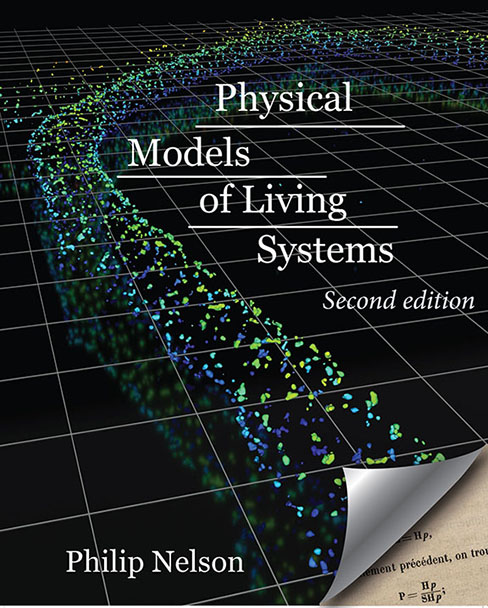
Second ed., revised, clarified, updated, and enlarged (Chiliagon Science, 2022). Available as an e-book from Amazon. For a hard copy, check this link. The new edition is available in Chinese translation: 生命系统的物理建模(第二版) at these
two links.
Responses to the new edition:
"What I find special about this book is its elegance in transitioning from fundamental math to applications in biology and the analysis of real-world data. The book chapters integrate together beautifully and the problem sets are a rare asset." -- Prof. Amir Erez, Hebrew University
"An excellent book, well written and beautifully illustrated.... Lots of homework problems, comparisons to real data, and a winning combination of words, pictures, equations, and computer code... a masterpiece." -- Prof. Bradley Roth, Univ. of Oakland
"A wonderful textbook. It stretches life science students to not only see but also understand how randomness at the heart of living systems can lead to predictable outcomes. Students in my class, taught using PMLS, found the text to be intellectually challenging and, as a result, interesting and memorable." -- Prof. Douglas Martin, Lawrence University
Reviews of the first edition:
"Particularly compelling for its smooth integration of biological experiments, physical
models, and computational exercises. Readers who complete the text will be well equipped
with the computational and mathematical skills needed for a quantitative understanding of a
range of biological systems.... Thanks to Nelson's skillful writing and the excellent
accompanying online resources, this book will appeal to a broad audience and teach even a
beginner how to solve problems numerically." -- Eva-Maria Collins
in Physics Today
"Philip Nelson has done a terrific job.... There are numerous traits that make this text
unique among the very many books of biological physics.... The presentation of materials
is developed in an innovative fashion.... There is a nice balance between conceptual
examples and end-of-the-chapter problems....
Physical Models of Living Systems.... will benefit undergraduates as well as
others with clear interests in genomics, proteomics, cellular signaling, bioengineering,
regenerative medicine, and synthetic biology." -- Liviu Movileanu in American Journal of
Physics 84 (6), June 2016
"[T]his excellent book will appeal to both students and professional scientists in the field
of quantitative biology.... [T]he book feels personal in its selection of topics and the
training journey on which it takes its readership. In our opinion, the combination of this
uniqueness with technical accuracy makes the book a noteworthy and valuable addition to
resources for advanced biophysics education... [T]he book conveys rich information, is
clearly structured, and provides comprehensive data sets... Nelson shows how computational
programming can be used effectively in modeling biological systems at the cellular and
molecular levels." -- Dietlind L. Gerloff
and Jonghoon Kang. Cell Biology Education (2016) vol. 15 (4) pp. fe11-fe11.


![[picture]](Gifs/tinyAJPwindows.png)
![[picture]](Gifs/tinystochsim2.jpg)
![[picture]](Gifs/tinyFRET.png)
![[picture]](Gifs/tinytransduction.gif)
![[picture]](Gifs/tinymyoWalk.png)
![[picture]](Gifs/tinydroso200x130.png)
![[picture]](Gifs/tinyreceptive225x130.png)
![[picture]](Gifs/tinyPhilOFF.GIF)
![[picture]](Gifs/tinyTIRF.gif)
![[picture]](Gifs/tinyMEA.gif)
![[picture]](Gifs/tinyCalibr.jpg)
![[picture]](Gifs/tinylengthtrace.jpg)
![[picture]](Gifs/tinybeausangtwirl.jpg)
![[picture]](Gifs/tinykuliclogo.jpg)
![[picture]](Gifs/tinyTowles.jpg)