![]()
![]()
Phil Nelson
Physics and Astronomy University of Pennsylvania Philadelphia, PA 19104 USA phone: (215) 898-7001 fax: (215) 898-2010
Sorry, but I get a lot of e-mail. If you are a student currently enrolled in a class that I teach, or a Biophysics major advisee, put that in the subject line. I want to reply, but if I don't --- please come see me. If you wish me to review a grant proposal, article for publication, or promotion case, please don't assume that your e-mail has been read or even seen. It may be necessary to get me on the phone if you need me to do those things.
"The distinctive characteristic of the Analytical Engine... is the introduction into it of the principle which Jacquard devised for regulating the most complicated patterns in the fabrication of brocaded stuffs. It is in this that the distinction between the two engines lies. Nothing of the sort exists in the Difference Engine. We may say most aptly, that the Analytical Engine weaves algebraical patterns just as the Jacquard loom weaves flowers and leaves." -- Ada, countess of Lovelace, 1815-1853
I am a physicist.
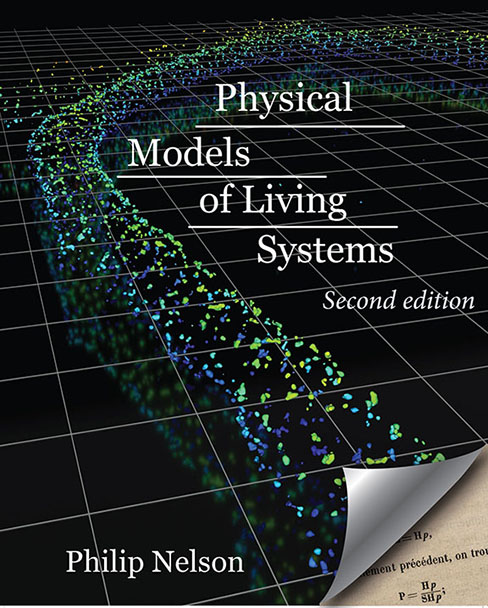
Some of what I know is in my book..
I teach some courses.
I'm also interested in K-12 education.
See our group's homepage.
Here is my boring official home page (with credo) and my vita.
I'm a member of Penn's Nano-Bio Interface Center, and the Institute for Medicine and Engineering.
I'm a member of Penn's Applied Math and Computational Science Graduate Group.
Physics of human and superhuman vision (Heinz Pagels Public Lecture, Aspen, 2011). Get it on vimeo or iTunesU.
Bill Berner's Physics demo shows! Get them via iTunesU or via vimeo.
Spare the (Elastic) Rod, Science 337, 1045 (2012).
Physics in the cell: Spring theory by Brendan Maher (Nature 448, 984-986 (30 August 2007)).
The great hunt for extra compliance by Jan Liphardt (Biophys. J. 2007).
Teaching Biological Physics, Physics Today 58:3 46 (March 2005).
Excerpt from a review of my book, published in The American Journal of Physics.
And another review published in Nature.
Here's one published in Biomedical Computation Review.
DNA Elasticity, in McGraw-Hill Yearbook of Science and Technology 1999. View this page in Romanian courtesy of azoft.
Statistical Mechanics of Membranes, from McGraw-Hill Yearbook of Science and Technology 1995. (Translation into Polish, courtesy Maksim Ivancov.)
"Information", Talk at American Society for Cell Biology, 12/2012.
Inference in Biological Physics, Talk at MIT, 10/2012.
Physics of Human and Superhuman Vision (Heinz Pagels Public Lecture, Aspen, 2011).
Keeping the Physics in Biophysics, and Vice Versa (Oxford University, 2010).

The research in these publications was funded in part by The National Science Foundation and by the Human Frontier Science Program. "Any opinions, findings, confusions, contusions, contortions, and conclusions or recommendations expressed in this material are those of the author(s) and do not necessarily reflect the views of the National Science Foundation."
Note: PDF reprints are provided below within the context of fair use. Please obtain copies from the publisher if appropriate.
![]() |
Does a molecular motor pause to search for its next stepping spot? Three-dimensional orientation and dynamic wobble of myosin V by high time resolution single molecule polarized fluorescence. With Beausang, Schroder, and Goldman. Biophysical Journal (in press). |
| How does a wave of cell division spread across an embryo? Wavefront propagation and mechanical signaling in early Drosophila embryos. With Idema, Dubuis, Manning, and Liu. Submitted. |
![]() |
![]() |
How much data compression is occurring in your retina? Retinal adaptation to spatial correlations. With Simmons, Prentice, Tkacik, Homann, and Balasubramanian. Submitted. |
| What is each retinal ganglion cell looking for? Neural Spikes, Identification from a Multielectrode Array. With Prentice, Homann, Simmons, Tkacik, Balasubramanian. Encyclopedia of Applied and Computational Mathematics, in press. |
![]() |
How precisely can you pinpoint a rate change? Changepoint analysis for single-molecule polarized total internal reflection fluorescence microscopy experiments. With Beausang and Goldman. Methods Enzymol. 487 431-463 (2011). | .
| When we eavesdrop on a retina, who said what when? Fast, scalable, Bayesian spike identification for multi-electrode arrays. With Prentice, Homann, Simmons, Tkacik, and Balasubramanian. PLoS ONE 6(7): e19884. |
![]() |
![]() |
How should you design the right DNA to make the best measurements of looping? Calibration of Tethered Particle Motion Experiments. With Han, Lui, Blumberg, Beausang, and Phillips.In Mathematics of DNA Structure, Function and Interactions, eds. C.J. Benham et al. (Springer, 2009). |
![]() |
How can we monitor gene-regulatory events without any cells? Concentration and Length Dependence of DNA Looping. With Han, Garcia, Blumberg, Towles, Beausang, and Phillips. PLoS ONE, 4 e5621 (2009). |
| Does myosin twist the `wrong' way around actin as it walks? Twirling of actin by myosins II and V observed via polarized TIRF in a modified gliding assay. With Beausang, Schroeder, and Goldman. Biophys J. 95 5820 (2008). |
![]() |
![]() |
Is there spooky action at a distance in living cells? The Role of Microtubule Movement in Bidirectional Organelle Transport. With Kulic, Brown, Kim, Kural, Blehm, Selvin, and Gelfand. PNAS 105 10011 (2008). (See also the amazing movies.) |
| How does a regulatory protein manage to grab two distant places on a strand of DNA? First-principles calculation of DNA looping in tethered particle experiments, final version, and its supplement. With Towles, Beausang, Garcia, and Phillips. Physical Biology, 6 025001 (2009). |
![]() |
![]() |
When experiments seem to imply that the stiffness of DNA depends on its length, what's really going on? Elasticity of short DNA molecules: Theory and experiment for contour lengths of 0.6--7 um. With Seol, Li, Perkins, and Betterton. Biophys. J. 93 4360 (2007). |
| How accurately can we infer the length of a long molecule from the motion of a bead on its end? Colloidal Particle Motion as a Diagnostic of DNA Conformational Transitions. Current Opinion in Colloid and Interface Science 12 307 (2007). |
![]() |
![]() |
Are there long-lived kinetic substates in DNA looping? Diffusive hidden Markov model characterization of DNA looping dynamics in tethered particle experiments . With Beausang. Physical Biology 4 205 (2007). |
| How can you extract kinetics from noisy data without binning? DNA looping kinetics analyzed using diffusive hidden Markov model . With Beausang, Zurla, Manzo, Dunlap, and Finzi. Biophys. J. 92, L64 (2007). |
![]() |
| Are there hidden regularities in "random" Brownian motion? Elementary simulation of tethered Brownian motion. With Beausang, Zurla, Sullivan, and Finzi. Am. J. Phys. 75, 520 (2007). |
| What energy source squirts viral DNA into a host cell? Biological Consequences of Tightly Bent DNA: The Other Life of a Macromolecular Celebrity . With Garcia, Grayson, Han, Inamdar, Kondev, Phillips, Widom, and Wiggins. Biopolymers 85, 115 (2007). |
![]() |
If DNA is a stiff elastic rod, how can it form those tight regulatory loops? High flexibility of DNA on short length scales probed by atomic force microscopy. With Wiggins, van der Heijden, Moreno-Herrero, Spakowitz, Phillips, Widom, and Dekker.Nature Nanotechnology 1, 137 (2006) A commentary appears here. See the Erratum to this article. |
| Do cells transport vesicles using active conveyor belts? Hitchhiking Through the Cytoplasm. With Kulic. Europhys. Lett. 81, 18001-(1--6) (2008). |
![]() |
![]() |
How can you see protein binding in real time? Entropic elasticity of DNA with a permanent kink. With Betterton and Li. Macromolecules 39 8816 (2006). |
| When you twist a string, how does that affect loop formation? Effect of supercoiling on formation of protein mediated DNA loops. With Purohit. Phys. Rev. E74, art. no. 061907 (14 pages) (2006). See the Erratum to this article. |
![]() |
| How can you detect DNA looping in real time, when you can't even see DNA? Tethered particle motion as a diagnostic of DNA tether length. With Zurla, Brogioli, Beausang, Finzi, and Dunlap. Journal of Physical Chemistry B110, 17260 (2006). |
![]() |
![]() |
How can fluorescence tell us about molecular mechanics? Generalized theory of semiflexible polymers. With Wiggins. Phys. Rev. E73, art. number 031906 (2006). |
| What can a balloon in a hurricane tell us about gene regulation? Excluded-Volume Effects in Tethered-Particle Experiments: Bead Size Matters. With Segall and Phillips. Phys. Rev. Lett. 96 art. number 088306 (2006). |
![]() |
![]() |
How does DNA spontaneously form gene regulatory complexes with
"impossibly" tight loops? Exact theory of kinkable elastic polymers . With Wiggins and Phillips. Phys. Rev. E71 art. number 021909 (2005). |
| Is single-stranded DNA really a freely jointed chain? Theory of High-Force DNA Stretching and Overstretching. With Storm. Phys. Rev. E67 (2003) art. number 051906 (Erratum ibid. 70, 013902 (2004)). |
![]() |
![]() |
What's going on when DNA stretches to 1.6 times its "maximum" length? The bend stiffness of S-DNA. With Storm. Europhys. Lett. 62 (2003) 760. |